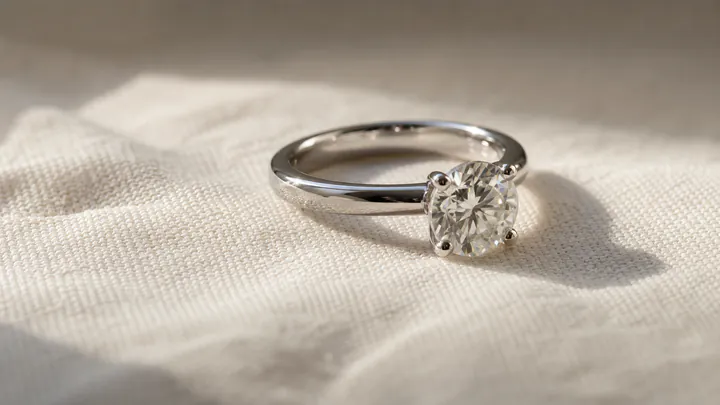
Short answer: judge an emerald cut with your eyes rather than off a spec sheet, and buy it from a manufacturer, cutting house or dealer.
- No cut grade exists. GIA gives a full cut grade to round brilliants and, as of 2026, none to emerald cuts, so the one line telling you whether a stone is crisp or watery is missing from the certificate. Hold VS2 as the clarity floor, lean to VS1, and pick the ratio on a real hand.
- Cheaper. A retail counter buys at trade level and then roughly doubles the price, nearer three times at a branded name. One step earlier is the same stone without that doubling.
- Better. Clean crystal at the ratio you want is about five times more common up the chain: 52 percent of trade-access stock reaches D to G with VS2 or better, against 9 percent of retail-held stock. On the shape that needs clean crystal most, that gap decides everything.
- They make and mend it too. The mount gets cut around your stone’s actual outline, which matters on a shape whose corners are its weak point, and resizing, re-tipping, valuations and repairs run off the same bench. Most dealers, manufacturers and cutting houses run one or work with one. A counter mostly sends that work out.
Use a showroom instead if the ring is needed by a date that will not move, if you want to lay emerald cuts beside Asschers and radiants on a real hand in one afternoon, or if the name inside the box matters to you.
The rest of this page is why that answer looks the way it does. It starts from a gap: GIA’s fancy-shape cut grades only begin rolling out from 2027, starting with the marquise, oval and pear, with step cuts like the emerald expected later. So two emerald cuts with the same colour, clarity and carat weight on paper can look like completely different stones in the hand, one bright and architectural, one flat and watery. That gap is the whole story of buying this shape well in South Africa, and it is why I never let anyone choose an emerald cut from a spec sheet alone.
Why the emerald cut is the honest shape, and the unforgiving one
The emerald cut is a step cut. Instead of the dozens of small triangular facets that make a round brilliant throw sparkle, it has long parallel facets that run like steps down to the culet. That gives it the clean, architectural, hall-of-mirrors look that Art Deco buyers love. It also means two things you have to respect.
First, it does not hide inclusions. A round brilliant scatters light so busily that a small feather or crystal disappears. The open table of an emerald cut acts like a sheet of glass. You look straight in, and anything sitting near the centre is visible. This is why I treat VS2 as a floor and lean towards VS1 for emerald cuts specifically, while I would happily take a well-placed SI1 in a round. It is not about the grade on the report, it is about where the inclusion sits. Ask to see the GIA plot and look for anything parked under the centre of the table.
Second, it shows its body colour and its flaws in cut more plainly. A poorly proportioned emerald cut “windows”, meaning you can see straight through the middle to the finger below because the facets are not returning light. A good one has life and contrast across the steps. You cannot read either of those off a certificate. You have to see the stone move in daylight, which is exactly why I push so hard on video and in-person inspection for this shape. Here Johannesburg has a quiet advantage. GIA runs a laboratory in the city, and it grades on its own premises rather than at any seller’s, so a local stone can be independently graded without leaving the country. What that proximity buys you is time in front of the diamond: a seller who is actually holding the stone can put the graded emerald cut on the tray, and you can look straight through the table and verify the report number yourself before you decide.
Ratio is the decision most people get wrong
Carat weight tells you how heavy the stone is. Length to width ratio tells you what it actually looks like on the hand, and for an emerald cut it matters more than for almost any other shape. A classic emerald sits around 1.40 to 1.50. Drop towards 1.30 and it reads square and starts to resemble an Asscher. Push past 1.60 and it looks long, slim and elegant but covers the finger differently. None of these is wrong, but a buyer who fixates only on carat can end up with a perfectly graded stone in a shape they did not want. Choose the outline first, on a real hand, then the weight.
There is also a quiet value angle here. An emerald cut that is cut deep hides weight in its pavilion, so it can face up smaller than its carat suggests, while a well-proportioned, elongated one spreads its weight and faces up large for the same carat. Either way, do not buy face-up size off the carat figure: judge it by the millimetre spread on the report, and if presence matters, favour a slightly longer ratio or a marginally larger stone.
What an emerald cut really costs in South Africa
Shape changes the look, not the underlying pricing logic. What changes for an emerald cut is where on the grade ladder you are forced to start, and that is where the money goes. Our June 2026 inventory count matters more to this shape than to any other. Across 230 GIA-certified natural diamonds listed by six South African sellers on 26 June, 9 percent of the stock actually held in South African retail met premium specification, meaning D to G in colour with VS2 clarity or better. Stones reached through trade access met it 52 percent of the time. VS2 is the floor for a step cut, so the shape that most needs clean crystal is the one being asked to shop in the part of the market where roughly one stone in eleven qualifies. That is the real reason emerald cut buyers keep having to choose between the clarity and the ratio. They rarely find both in the same case.
On price, a loose one carat G/VS1 works out at roughly R72,000 to R92,000 including VAT on the published trade list: $5,400 per carat on the Rapaport round list of 20 March 2026, less 10 to 30 percent, converted at 16.50 rand to the dollar with 15 percent VAT added. Our July 2026 sample of 73 rows, 71 of them carrying a price, across 18 sellers, 17 of them South African, put a one carat ring in a premium South African showroom at R105,000 to R428,000. That second figure is a finished ring with its setting inside the price, resting on three listings of three different specifications, so it is not the same object as the first and the gap between them is not a saving. Two caveats belong specifically to this page. The list behind the loose figure is the round brilliant list, and a step cut is not priced off it, so read that number as the weight and grade costing roughly that much in the market rather than as an emerald cut price. And no cut grade exists for an emerald cut at all, so neither figure tells you anything about how a particular step cut will actually look. The wider picture is in our South African diamond price index, worth reading before any showroom visit.
That inventory count also explains something most buyers never hear. The cheapest sticker is rarely the cheapest stone. When nine tenths of the stock in the case sits below D to G and VS2, a low headline usually means a diamond that has quietly given up colour or clarity, and a step cut is the one place where you cannot hide either. The route that does reach better goods carries its own catch, and it bites hardest on this shape. Bringing a stone in from a far larger catalogue is fine, and on emerald cuts a wide search is exactly how you find clean crystal at the ratio you want. What is not fine is that you pay before anyone has watched it move. An emerald cut shows its clarity and its life only in the flesh, so a stone nobody has tilted under a light is the worst possible arrangement on this shape.
How to find an emerald cut worth inspecting
I cannot send you to a shop, because nothing on this site names a business. What I can tell you is which search puts the right sellers in front of you. Looking for a diamond dealer or a wholesaler returns very little here and almost nobody searches that way. Search the price question instead, what a one carat diamond costs or the diamond price per carat in South Africa. A seller who publishes a per-carat number is a seller who expects to be compared on it, and in my experience that is also the seller who will put an unset stone on a tray and let you look through the table before any money moves. Ask for your chosen ratio, in VS1 or a well-placed VS2, on video first and in the hand second.
Then hold every one of them to an identical brief, because on this shape a quote is only comparable if the wording was. Give each seller the same ratio band, the same clarity floor, and the same request to see the plot and a video of the stone in motion before any money moves, and do not soften any of the three for the seller who is friendliest on the phone. The diamond buying checklist carries the rest of the questions in a fixed order. The one to add for a step cut is where the inclusions sit in relation to the centre of the table, because two stones can share a clarity grade and only one of them will be looking back at you through the glass.
Settings that suit a step cut
The emerald cut is happiest in a setting that respects its clean lines. A simple solitaire is the timeless choice and lets the step facets do the talking, though it leaves the corners more exposed, so I like protective V-tip prongs. Three-stone designs with tapered baguettes are a natural fit because they echo the architectural geometry. A halo adds sparkle and apparent size, but it can fight the calm, glassy character that drew you to the shape in the first place, so look at it in person before committing. If you want something built around your exact stone and ratio, a custom diamond ring is often the cleanest route for emerald cuts, because the setting can be cut to fit the precise outline rather than forced onto a stock mount.
Whatever you choose, the rule for this shape does not change. Buy the natural GIA stone, check where the inclusions sit, choose the ratio on a real hand, and watch it in daylight before any money moves.